Yokohama School – Hand-Colored Photography of Meiji & Taishō Japan
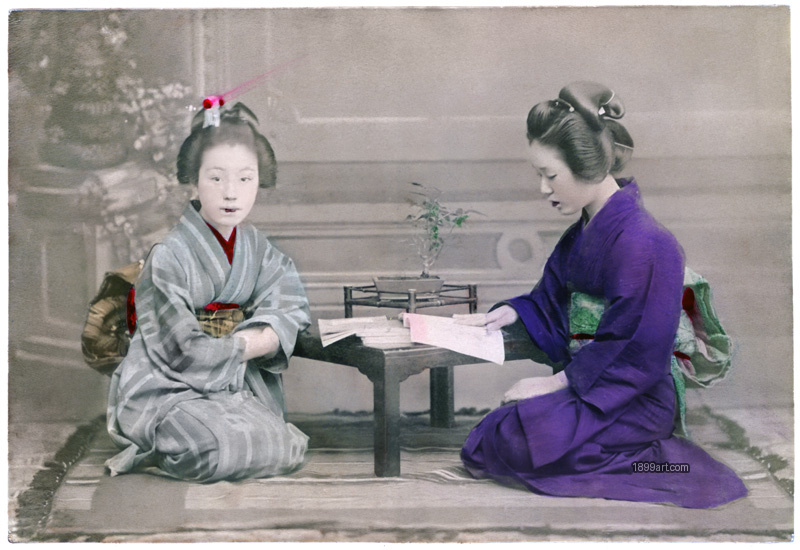
The term “Yokohama School” refers to a historical field of studios, workshops and photographers active in Yokohama roughly between 1860 and 1920. They created some of the most influential hand-colored photographs of Japan – images that shaped how the world saw the country.
This site serves as a reference point for the history, aesthetics and surviving works of the Yokohama School.
It is maintained as a dedicated subpage of 1899art.com.
What Is the Yokohama School?
The Yokohama School is not a formal institution. It is a historical and aesthetic tradition that emerged in the port city of Yokohama when Japan opened to the outside world. From the late 19th to the early 20th century, local studios combined imported cameras and lenses with Japanese painting skills and print culture.
The result was a distinct visual language: hand-colored photographs on albumen paper, collotypes and glass slides that blended documentary and staged scenes, everyday life and idealized images, commercial products and works of art.
Historical Background (c. 1860–1920)
Yokohama as a Photographic Hub
After Japan opened its ports in the mid-19th century, Yokohama became a key point of contact between Japanese artisans and Western photographic technology. The city developed into a dense photographic environment where foreign photographers, Japanese apprentices, painters, printers and merchants interacted closely.
Studios in Yokohama produced:
- early albumen prints and collotypes,
- large-format studio portraits and genre scenes,
- topographical views for travellers, diplomats and publishers,
- and, eventually, highly refined hand-colored photographs.
Early Foreign Studios and the Transitional Phase
In the earliest phase, photography in Yokohama was strongly influenced by foreign photographers and entrepreneurs. Figures such as Felice Beato (1832–1909) and Raimund von Stillfried-Ratenicz (1839–1911) played a key role in establishing photography as a commercial and cultural practice in the treaty ports.
Their studios introduced photographic workflows, international distribution networks and a market-oriented production model. At the same time, much of the practical labor — from camera operation to coloring and finishing — increasingly involved Japanese assistants and craftsmen.
This period should be understood as a transitional phase: it laid the technical and commercial groundwork, but did not yet constitute the mature visual language later associated with the Yokohama School.
Kimbei Kusakabe – Establishing a Japanese Visual Language
Kimbei Kusakabe (1841–1934) represents a decisive shift toward a distinctly Japanese-controlled photographic practice. Having trained within earlier studio environments, Kimbei built one of the most influential studios in Yokohama and refined a stable, recognizable visual style.
Kimbei’s operation is central to the Yokohama School because it defined:
- a consistent repertoire of motifs (street scenes, tea houses, studio portraits, landscapes),
- a recognizable hand-coloring palette and brush technique,
- and a workshop-based production model integrating photographers and specialized colorists.
T. Enami – Technical Refinement and Serial Production
T. Enami (Tamotsu Enami, 1859–1929) belongs to the second generation of Yokohama School photographers. His work is characterized by technical clarity, fine optics and carefully structured compositions.
Enami’s studio is particularly significant for:
- stereoscopic glass views,
- hand-colored lantern slides for projection,
- and serial motifs reproduced across multiple formats and scales.
Workshops, Colorists and Techniques
The distinctive appearance of Yokohama School photography depends as much on the work of colorists as on the photographers themselves. Many colorists came from backgrounds in ukiyo-e, painting or decorative arts.
They worked with:
- limited but expressive pigment sets,
- intense reds, greens and blues designed to survive dim projection and artificial light,
- layered applications creating depth on flat albumen surfaces,
- and fine brushes capable of modeling faces, textiles and architectural detail.
Some colors that appear unusually strong today are a direct result of these viewing conditions. Many photographs were intended to be seen under gaslight or early electric illumination, where much of the saturation would be absorbed.
A Shared Visual Field
Studios in Yokohama and other cities often shared models, props, gardens and backdrops. The same geisha, monk or street vendor might appear in slightly altered poses across multiple catalogues and formats.
Because of this, many photographs from the Yokohama School are closely related in style. In numerous cases, an exact attribution to a single photographer is impossible or disputed. This does not diminish their value; instead, it underlines that the Yokohama School is best understood as:
- a collective field of studios and workshops,
- a shared aesthetic vocabulary,
- and a flexible tradition rather than a fixed list of names.
This site therefore focuses on context, technique and visual coherence, not on speculative attributions where evidence is weak.
Copyright
Images from the 1899art Archive may be linked, shared, and embedded on external websites only in their original, unmanipulated form, provided that clear attribution to “1899art” is given and a visible link to https://1899art.com is included. Any modification, alteration, recomposition, recoloring, AI processing, or commercial reuse beyond simple linking and sharing is not permitted without prior written consent.
Contact & Credits
Purpose of this site
YokohamaSchool.org is intended as a reference and context resource for the history and surviving works of the Yokohama School of hand-colored photography.
It does not claim to be complete and will be expanded over time.
A curated project of the
1899art Archive.
Contact
📧 contact@yokohamaschool.org
Focus
Historical research, visual analysis, digital preservation and curated examples of original works from the period c. 1860–1920.
This website is currently in its early phase. Further sections on sources, studios and bibliography will follow.
YokohamaSchool.org is part of the wider 1899art project: www.1899art.com.
Usage Rights & Legal Notice – 1899art Archive
All images published on 1899art.com originate from the 1899art Archive and are provided for cultural, educational, and historical reference purposes only.
Permitted use
Images may be linked, embedded, or shared on external websites and platforms exclusively in their original, unmanipulated form, provided that:
– the source is clearly credited as “1899art”, and
– a visible and clickable link to https://1899art.com accompanies the image.
Prohibited use
Any form of modification, including but not limited to cropping, retouching, recoloring, compositing, filtering, AI-based processing, or the creation of derivative works, is strictly prohibited without prior written permission.
Commercial use, resale, redistribution as standalone files, or inclusion in third-party archives or databases is also not permitted without explicit authorization.
Rights status
While the original photographs may be in the public domain due to age, the digital reproductions, curatorial selection, restoration decisions, metadata, and contextual presentation are the intellectual property of the 1899art Archive.
By using images from this website, you agree to respect these conditions.
Automated downloading, scraping, or use of images for machine learning or AI training purposes is expressly prohibited.
EU / International Copyright Notice
All images published by the 1899art Archive are protected under European and international copyright law.
Any reproduction, redistribution, modification, AI-based processing, or commercial use beyond the explicitly permitted low-resolution web sharing is prohibited without prior written consent of the 1899art Archive.
This applies equally to high-resolution files obtained through unauthorized access, third-party leaks, or archival reproductions.
DMCA Copyright Notice & Protection
All images and digital files published by the 1899art Archive are protected by international copyright law and the Digital Millennium Copyright Act (DMCA).
Unauthorized reproduction, distribution, modification, AI processing, or commercial use of any image or high-resolution file from the 1899art Archive is strictly prohibited.
The unauthorized possession or dissemination of high-resolution files does not constitute a license and does not grant any rights of use.
Any infringement will result in DMCA takedown notices, platform removal requests, and, where applicable, legal action.